Cataloging & Classification Quarterly
Carter, Ruth C, and Elizabeth Ruth Baughman. n.d. Cataloging & Classification Quarterly.
Notes
- Erwin Panofsky's Theory
- First level of meaning - Pre-iconography
- primary and natural subject matter - “generic description of the objects and actions represented in the picture” (Carter and Baughman, p. 43)
- factual (Of)
- relatively objective
- “what the picture is Of” (Carter and Baughman, p. 43)
- expressional (about)
- subjective
- “what it is About” (Carter and Baughman, p. 43)
- factual (Of)
- primary and natural subject matter - “generic description of the objects and actions represented in the picture” (Carter and Baughman, p. 43)
- Second level of meaning - Iconography
- secondary or conventional matter
- “requires a familiarity with a specific culture that goes beyond "everyday familiarity with objects and events."” (Carter and Baughman, p. 44)
- “Iconographical analysis enables us to identify specifically what a picture is Of. but also to perceive allegories, personifications, and symbols. to analyze what a picture is About.” (Carter and Baughman, p. 44)
- Third and final level of meaning - Iconology
- iconography is analysis whereas iconology is interpretation
- First level of meaning - Pre-iconography
- Connect/Disconnect between words and images
- In generative AI esp. the words are used to describe the image and generate them. However, there can be significant differences between the meaning in image and meaning in language.
- “It may be obvious that words are different from images, but a failure to analyze this difference, to recognize its implications, has led to unresolved problems in describing the subjects of pictures: for example, the problem of whether a picture of a specific building should be found under the name of specific building (as it would be if it were a book about the building) or under a generic term for the building type (i.e., sky scraper). which violates the book-based principle that the more specific term should be used when there is a choice.” (Carter and Baughman, p. 46)
- In generative AI esp. the words are used to describe the image and generate them. However, there can be significant differences between the meaning in image and meaning in language.
- Referential theory
- Words have senses and reference and two are not in correspondence
- "evening star" and "morning star" have different senses but the same referent
- The process is reversed in images.
- The senses doesn't determined the range of referents. The referents determine the senses.
- “When one looks at a picture, the process is reversed: the sense of a pic ture does not determine the range of its referents, the referents determine the sense of the picture. In order to apply referential theory to the twodimensional universe of pictures and their subjects, referents in this con text are defined as the images that appear in a picture, not as the actual ob jects or actions that they represent.” (Carter and Baughman, p. 46)
- Words have senses and reference and two are not in correspondence
- Expanding Panofsky's
- Generic Of - Pre-iconography
- “Panofsky's pre-iconographic level of meaning is equivalent to the generic meaning of an image: let us call it Generic Of” (Carter and Baughman, p. 47)
- Specific of - Iconographic level of meaning
- “Specific Of may be described as an aspect of Panofsky's iconographic level of mean ing” (Carter and Baughman, p. 47)
- About
- “However, aside from mythical beings or locales, About words describe emotions and abstract concepts, and may be thought of as inherently generic” (Carter and Baughman, p. 47)
- Generic Of - Pre-iconography
- “The different facets for the classification of the subjects of pictures may be defined initially as containing the answers to the series of questions Who? What? When? and Where? Each of these basic facets may then be subdivided into aspects based on Of in the specific sense. Of in the generic sense, and About.” (Carter and Baughman, p. 48)
- Ranganathan's Colon Classification
- Personality
- Matter
- Energy
- Space
- Time
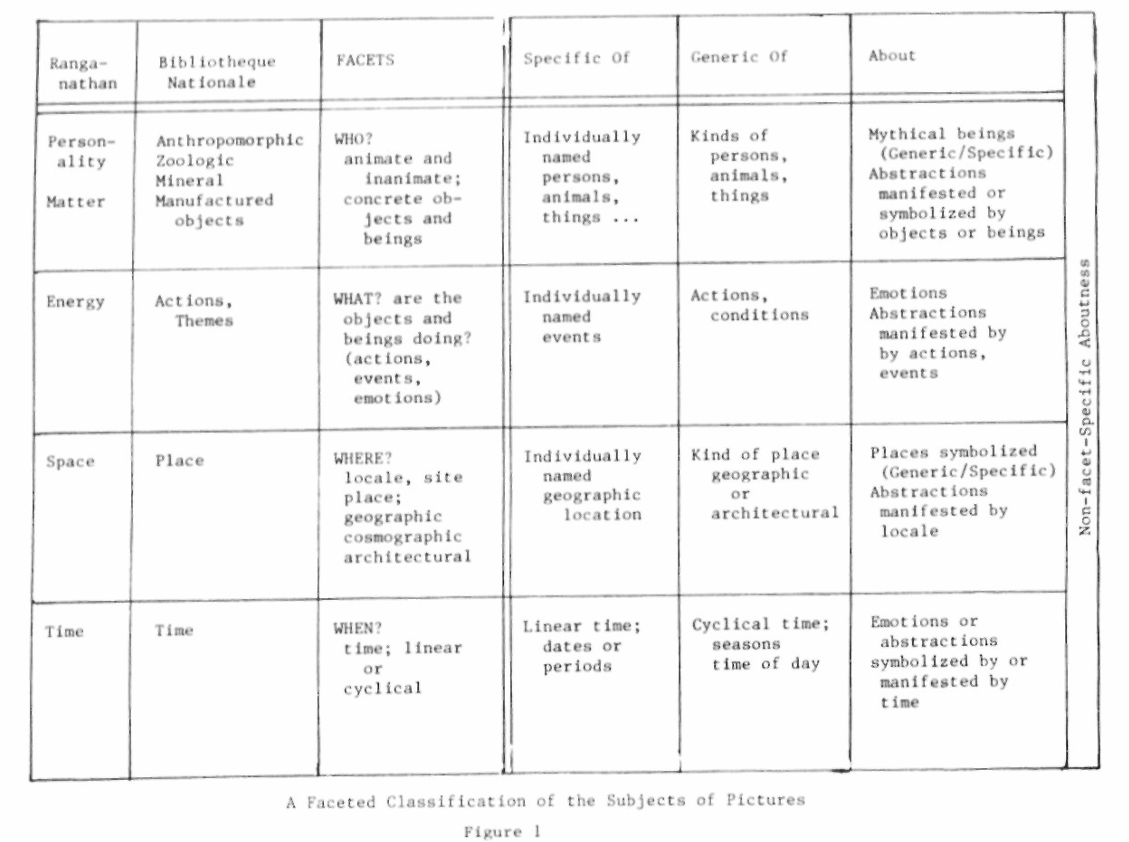
- Represented Work
- Text is a surrogate by convention; Pictures are surrogates by projection
- “A Represented Work is a particular kind of subject that a picture can have, but that a text cannot. A picture is Of a tangible object in a way that a text, composed of words, can never be. James J. Gibson, in an essay on pictorial perception, points out that although words and pictures can both be surrogates for objects, words are surrogates by convention, while pictures are surrogates by projection.21 That is, words in a text describe an object because convention has assigned them certain meanings, while a representational picture is a projection of the object itself. On the other hand, the projection must not be confused with the original object: no copy of a work of art, no matter how close it may be to the original, is anything more than a picture Of the original. Indeed, presenting a copy as an original, especially in the world of art dealers and investors, is a criminal offense.” (Carter and Baughman, p. 51)
- Considerations for indexing a picture
- First consideration: “nature and intended use of the collection of which it is a part” (Carter and Baughman, p. 54)
- two kinds of collection
- intended for users with specified purpose or subject interest
- intended for general unspecified use - While indexing for Aboutness, subjectivity is inevitable.
- The subjectiveness should be thoughtful aiming for a greater "recall" than "precision"
- First consideration: “nature and intended use of the collection of which it is a part” (Carter and Baughman, p. 54)
In-text annotations
"But pictures can be more than this: they can reveal "what a period looked like," social and historical insights, even psychological or philosophical ones. Representational pictures are a "literal portrait of their era";4 even non-representational art is "an in direct document because it is a reflection of the culture that spawned it."5" (Page 41)
"A nine teenth century painting of an eighteenth century event is apt to be less ac curate than a contemporary sketch; the image of a peacock in Early" (Page 42)
"Christian art symbolizes eternal life, while the same image in a later period may symbolize vanity." (Page 43)
"Panofsky's theory therefore seems capable of a broad application: it seems possible to apply it to any representational pictorial work." (Page 43)
"The first level of meaning Panofsky calls "pre-iconography," which he defines as "primary or natural subject matter, subdivided into factual and expressional."" (Page 43)
"Knowledge gained by practical experience of the world is all that is necessary for the recognition of factual and expressional meaning." (Page 43)
"The former describes what the picture is Of, the latter, what it is About. Factual meaning is relatively easy to describe and index, as people are more likely to agree on the description of an object or event than they are on the description of a mood or emotion, on the expressional meaning of a picture." (Page 43)
"Iconography is Panofsky's second level of meaning, which he calls "secondary or conventional matter."" (Page 44)
"requires a familiarity with a specific culture that goes beyond "everyday familiarity with objects and events."" (Page 44)
"The knowledge required for iconographic analysis is built on the practical knowledge that enables one to recognize factual and expressional meaning. It might be called "educated knowl edge" as it requires its possessor to have a "familiarity with specific themes and concepts as transmitted through literary sources, whether ac quired by purposeful reading or by oral transmission."15 Panofsky is ob viously using "literary sources" in a very broad sense, appearing to equate literary sources with any form of linguistic communication." (Page 44)
"Iconography incorporates the identification of specific (not generic) objects, as in the sitter for a portrait: it also incorporates the identification of images representing certain ideas, themes, or concepts, as in stories or allegories." (Page 44)
"Iconographical analysis enables us to identify specifically what a picture is Of. but also to perceive allegories, personifications, and sym bols. to analyze what a picture is About." (Page 44)
"pre-iconography is a description, iconography is analysis, and iconology is interpretation." (Page 45)
"Iconology is "intrinsic meaning of content"16 and requires a synthesis of information, of pre-iconographical and icon ographical information derived from the work itself, as well as knowl edge about the artistic, social and cultural setting to which it belongs. This level of meaning cannot be indexed with any degree of consistency." (Page 45)
"It is necessary to mention the iconological level of meaning in a discus sion of subject analysis, even though one does not intend to index it. because iconological interpretation is based on accurate pre-iconographic description and correct iconographical analysis of a picture." (Page 45)
"it is relevant to try to determine and define any differences that exist between meaning in pictures and meaning in language, in order to discover any effects these differences might have on the subject analysis of pictures" (Page 46)
"It may be obvious that words are different from images, but a failure to analyze this difference, to recognize its implications, has led to unresolved problems in describing the subjects of pictures: for example, the problem of whether a picture of a specific building should be found under the name of specific building (as it would be if it were a book about the building) or under a generic term for the building type (i.e., sky scraper). which violates the book-based principle that the more specific term should be used when there is a choice." (Page 46)
"According to Frege's exposition of this theory, words have senses (Sinn) and reference (Bedeutung), and these two are not in correspondence. In his classic example, the words "evening star" and "morning star" have different senses but the same referent." (Page 46)
"When one looks at a picture, the process is reversed: the sense of a pic ture does not determine the range of its referents, the referents determine the sense of the picture. In order to apply referential theory to the twodimensional universe of pictures and their subjects, referents in this con text are defined as the images that appear in a picture, not as the actual ob jects or actions that they represent." (Page 46)
"If images may be defined as referents for the sense of the words used to describe them, it seems clear that we cannot expect images to translate neatly and simply into words. As the sense of a word is associated with a number of individual images (referents), so too is a single image (referent) associated with many possi ble senses. In analyzing the subjects of a picture, we are really trying to determine the possible senses of the referents before us." (Page 46)
"Panofsky's pre-iconographic level of meaning is equivalent to the generic meaning of an image: let us call it Generic Of" (Page 47)
"Specific Of may be described as an aspect of Panofsky's iconographic level of mean ing" (Page 47)
"However, aside from mythical beings or locales, About words describe emotions and abstract concepts, and may be thought of as inherently generic" (Page 47)
"The different facets for the classification of the subjects of pictures may be defined initially as containing the answers to the series of questions Who? What? When? and Where? Each of these basic facets may then be subdivided into aspects based on Of in the specific sense. Of in the generic sense, and About." (Page 48)
"Two examples will suggest how these questions might be answered. First, consider a photograph of the Guaranty Building (designed by Louis Sullivan) in Buffalo, New York. This picture might have in the Who facet: Sullivan's Guaranty Building (Specific Of); Skyscraper (Generic Of); and Modern Architecture (About—Manifestation of an abstraction). Second. Sir Joshua Reynolds' portrait of Mrs. Siddons as the Tragic Muse might have: Mrs. Siddons (Specific Of); Woman (Generic Of); and Mel pomene/Muse (About—Mythical being). Depending on the nature and use of the collection, one might use Office Building instead of Skyscraper in the first example, or Actress instead of Woman in the second. Or one might assign two (or more) Generic Ofs to the same Specific Of; how ever. the categorization of the subjects remains the same." (Page 50)
"In each case we have a work (of art or architecture) represented in another work (a repro duction or photography): we have a Represented Work." (Page 51)
"Although at first this concept of Represented Work may seem con trived, a little thought will reveal not only the philosophical neatness of the concept, but also its practical value. Let us take the philosophical or theoretical justifications first, and then examine the effect the concept might have on practice." (Page 51)
"A Represented Work is a particular kind of subject that a picture can have, but that a text cannot. A picture is Of a tangible object in a way that a text, composed of words, can never be. James J. Gibson, in an essay on pictorial perception, points out that although words and pictures can both be surrogates for objects, words are surrogates by convention, while pic tures are surrogates by projection.21 That is, words in a text describe an object because convention has assigned them certain meanings, while a representational picture is a projection of the object itself. On the other hand, the projection must not be confused with the original object: no copy of a work of art, no matter how close it may be to the original, is anything more than a picture Of the original. Indeed, presenting a copy as an original, especially in the world of art dealers and investors, is a criminal offense." (Page 51)
"First, although access to reproductions has been established as though the reproduction and the work were the same, the actual physical descrip tion has been of the reproduction, and not of the original work. Thus we frequently have the sort of confusing situation in which Reynolds' paint ing would appear to measure 9 x 15 cm., and be dated ca. 1970: infor mation corresponding, not to the original, but to the Huntington Library's postcard reproduction of it." (Page 51)
"By identifying the Represented Work as a particular kind of subject, but at the same time as a work with a description different from that of the work in which it is represented, these two problems can be solved. It is perfectly possible to choose not to provide access to a Represented Work, or, to provide access to the Represented Work and to nothing else, depending on the picture being analyzed and the collection to which it belongs. However, it is important to be aware that the choice is there to be made. Once made, the same principles of descriptive cataloging that are applied to describe and provide access to a work might also do the same for a Represented Work." (Page 52)
"The first consideration in indexing a picture must be the nature and in tended use of the collection of which it is a part" (Page 54)
"Essentially, there are two kinds of collections: those intended for users with a specified purpose or subject interest, and those intended for general unspecified use." (Page 54)
"However, it must be remembered that Aboutness tends to represent a subjective analysis of the picture on the part of the indexer." (Page 57)
"Thoughtful subjective classifications are to be encouraged ... it is conservative to err on the side of greater 'recall' from the file rather than greater 'precision' in selecting—which means freedom to ex press subjective feelings.35" (Page 57)